
Among Chicago’s boutique retail corridors, one pulls ahead while another falters
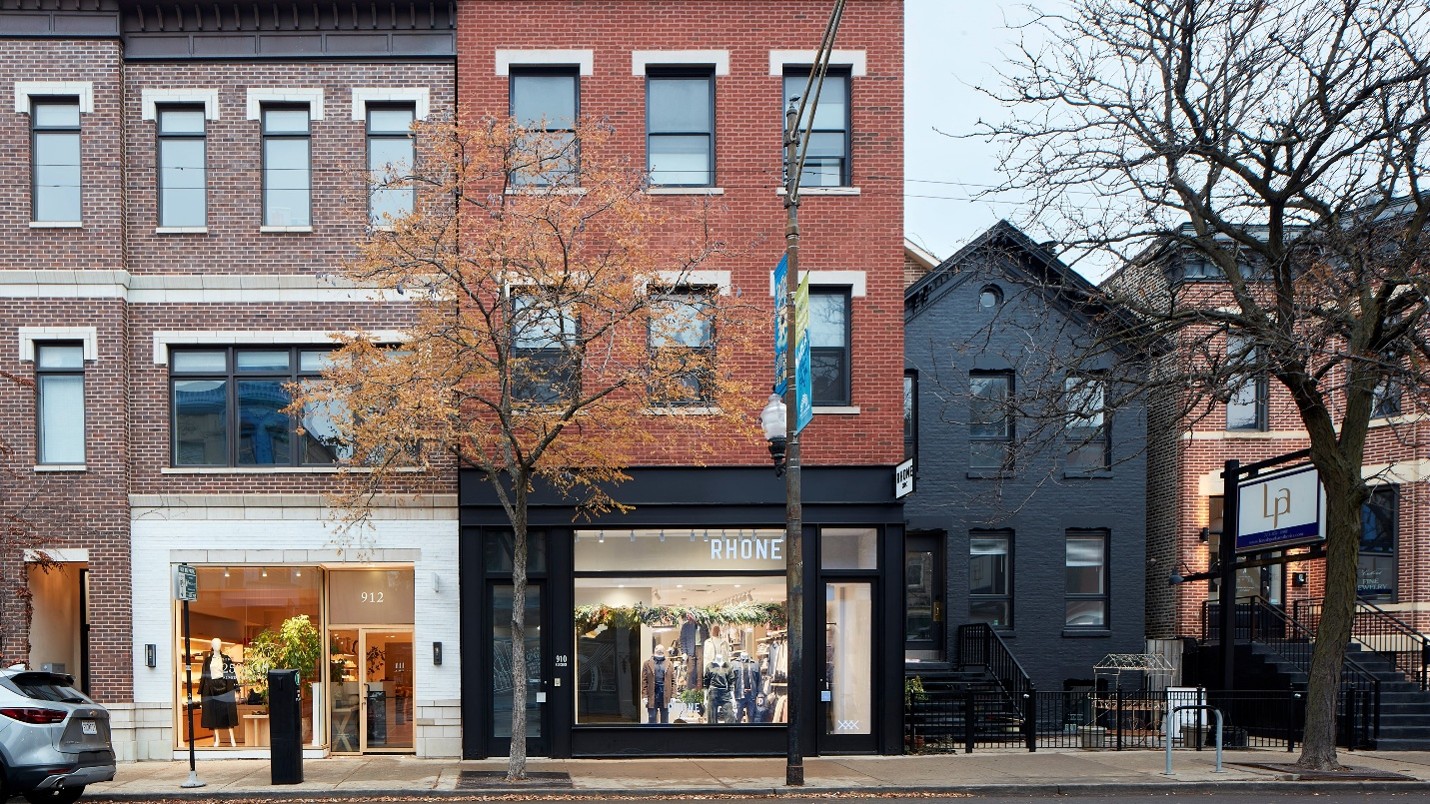
Activewear company Rhone opened in November at 910 W. Armitage Ave. (Pierce Harrison)
Among Chicago’s neighborhood retail corridors, Armitage Avenue has risen to the top.
The stretch between between Sheffield Avenue and Halsted Street achieved a 0% vacancy rate in 2025, dropping from 4.2% the year prior, according to a new analysis from Stone Real Estate.
That complete lack of vacancy marks “the culmination of a remarkable transformation” for Armitage, according to the report. Once the local counterpart to nearby Halsted, it is now the first place some national retailers look when they want to set up shop in Chicago.
“Armitage has long been on the national radar,” said Will Winter, vice president of Stone Real Estate. “It has kind of moved up another echelon because there are so many nationals on the street, and they all seem to be doing well.”
Stone’s annual report analyzes the shopping strips on Armitage, Damen and Southport avenues. Those three areas, considered Chicago’s primary boutique retail corridors, are often go-to spots for brands entering in the city. Their fates could influence Chicago’s ability to attract retailers.
They also serve as bellwethers for the city’s neighborhood shopping scene.
“It speaks to the strength of the neighborhood retail,” Winter said. “These are the everyday consumers.”
Armitage Avenue
On Armitage, the vacancy rate has been dropping for several years. The only long-term vacancy had been the building at 816 W. Armitage Ave. that once housed Charlie Trotter’s storied restaurant. That changed last year when Trotter’s son, Dylan, launched a dinner series out of the building, filling that lone vacancy.
“It tips the balance of the street into the landlord’s favor,” Winter said. “Landlords get to be increasingly selective with who they pick, and they get to drive rent.”
Rent is also a function of how much retailers can generate in revenue. Rents on that stretch of Armitage have almost doubled since before the COVID-19 pandemic, Winter said.
“That shows these retailers are performing,” he said.
Other newcomers to the street include active wear company Rhone and men’s clothing store Huckberry.
Rhone, which opened in November at 910 W. Armitage Ave., pays “close attention” to boutique retail corridors when it enters a new market.
“Those areas often provide valuable signals about where our customer is already shopping and spending time,” Chrissy Jackson, vice president of retail at Rhone, said in an email. “Armitage checked all of those boxes for us and felt like a natural fit for our first Chicago location.”
Though Rhone had a location in Oak Brook — which is a “strong performer for the brand,” Jackson said — the Armitage store was its first in the city.
“As we looked at expanding our footprint within the city itself, Armitage quickly emerged as the right opportunity,” Jackson said. “It gave us access to a highly engaged urban customer and a retail corridor with tremendous momentum.”
Southport Avenue
The vacancy rate between Addison and Roscoe streets ticked up to 1.6% in 2025, according to the report. It had held steady at 0% the previous two years.
However, there were only two vacancies. One was jewelry store Claire’s, which closed hundreds of stores after filing for Chapter 11 bankruptcy. The other was The UPS Store, which relocated to a larger space on Lincoln Avenue.
In other words, neither of the vacancies point to problems on Southport, Winter said. “I still think the underlying fundamentals of the street are really strong.”
Indeed, the report said that of the three boutique streets, “Southport’s evolution to a nationally dominated corridor has been the most dramatic.” In 2012, local stores accounted for 63% of the street. The balance has flipped, with national brands now accounting for 66%.
New retailers that opened on Southport last year include Portland Leather Goods, women’s clothing store Reformation and furniture store Lovesac.
The report predicts Southport will catch up with Armitage’s 0% vacancy rate soon.
Damen Avenue
The most dramatic increase in vacancies last year occurred on Damen, according to the report. The rate between Willow Street and North Avenue jumped to 18.5% from 12.9%.
“The worrying thing is most of the retailers that vacated these were all national retailers,” Winter said, pointing to Lululemon, Benefit Cosmetics, Club Monaco. “They’d been on the street for 10 years plus. That’s not a great indicator.”
Still, the vacancy rate on the street remains better than it was a few years ago, when the pandemic hit hard. Damen’s vacancy rate soared to nearly 30% in 2020, doubling the sub-10% rates the corridor enjoyed between 2013 and 2016.
The area first popped up as a hot shopping strip for edgy clothing brands because artists worked nearby. As it began to recover in 2022, a new identity started emerging. Service retailers like banks and veterinary clinics began replacing clothing stores. Families populate the neighborhood now more than working artists.
Now, it seems that identity could be refining itself. Among the new retailers are running shop Salomon and Bandit Running.
Likely, their presence speaks to the proximity of The 606 trail, Winter said. It officially opened over a decade ago, and has become a selling point for homeowners nearby.
Other newcomers to the street included cafe Hotel Chocolat and tasting menu restaurant Class Act.
“It’s been struggling to find an identity,” Winter said. “The hope would be that these new retailers . . . that have opened on the street are better aligned with that customer base.”